
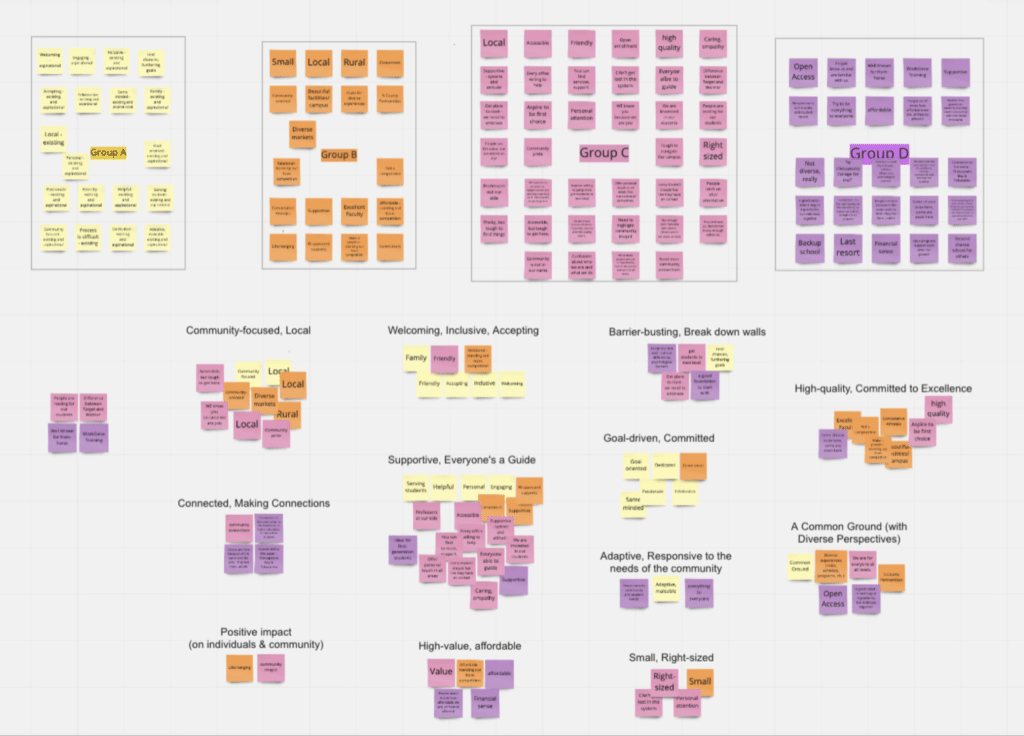
If you work in higher ed marketing, you’ve probably had this experience: remove the logo from a college homepage, and the copy could belong to several institutions. Community. Opportunity. Belonging. Career preparation. Personalized attention. Each idea can be true. The problem starts when you can transfer the promise to a competitor with almost no editing.
And increasingly, it’s an enrollment issue, too. In a July 2026 survey of 134 enrollment leaders, brand recognition and differentiation was the most common challenge cited, named by 30% of institutions. One respondent put it plainly: Their competitors were “seemingly everyone.”
That’s why we wanted to move beyond anecdotes and measure what institutions actually say on their homepages. We examined 50 four-year college and university sites across 31 states and all four census regions. The point wasn’t to shame familiar language. We wanted to see where that language stops doing the job a brand needs it to do.
Across 50 homepages, 48 hero headlines could be moved to a competitor’s site with no edit other than the institution’s name. Thirty-eight paired their central claim with no verifiable statistics at all: no number, no sourced ranking, no named program, no price, no outcome. Thirty-seven homepages, nearly three-quarters of the sample, were both interchangeable and unproven.
What we found
- 48 of 50 hero headlines would work on a competitor’s site after swapping the name.
- 38 of 50 made their central claim with no verifiable specifics beside it.
- 0 of 50 led with a graduate outcome figure.
- 15 of 50 published outcome data further down the same page.
- 1 of 50 published a graduation or retention rate anywhere on the homepage.
The Words Higher Ed Can’t Stop Using
A homepage has little space to answer a hard question: Why spend another minute with this institution? That pressure produces shorthand. Community, future, opportunity, career, innovation, belonging. Each carries a lot of institutional intent in very few words.
It’s understandable why homepages end up this way. Hero space is some of the most contested real estate on campus, with admissions, advancement, academic units, and leadership each making a fair case for it. Copy then moves through rounds of review, and each round favors language no stakeholder can object to. The words that make it through tend to be the broad ones.
The problem? Shorthand loses power when everyone reaches for the same vocabulary.
Sixteen themes accounted for nearly all of the language we coded. Opportunity appeared on 36% of homepages, transformation on 32%, community on 30%, and a reference to the future on 26%. Eighty-two percent invoked at least one of the six most common themes and 60% invoked two or more, which is why so many of these pages feel like variations on one page. Three institutions in our sample lead their homepages with the identical headline: “You Belong Here.”
| Theme | Homepages (of 50) | Share |
|---|---|---|
| Opportunity | 18 | 36% |
| Transformation/becoming | 16 | 32% |
| Community | 15 | 30% |
| Future/what comes next | 13 | 26% |
| Belonging | 10 | 20% |
| Discovery/exploration | 10 | 20% |
| Excellence/quality | 10 | 20% |
| Faith/values | 7 | 14% |
| Impact/changing the world | 7 | 14% |
| Place/location | 6 | 12% |
| Hands-on/experiential learning | 6 | 12% |
| Career outcomes | 5 | 10% |
| Personalized attention | 4 | 8% |
| Innovation | 3 | 6% |
| Access/inclusion | 2 | 4% |
| Affordability | 2 | 4% |
| Research | 0 | 0% |
The bottom of that list is more interesting than the top. Career outcomes appeared on 10% of homepages. Affordability appeared on 4%. Our own undergraduate research identifies those two subjects as the strongest early-stage motivators, and the least-used ideas on the sector’s front door.
The anatomy of a higher ed headline
Homepage headlines are as uniform in form as they are in vocabulary.
- Length: 4.9 words on average, with a median of four.
- Purpose: Six homepages use the hero for an event or a deadline rather than a message. Homecoming week. Open house. Applications open.
- Address: 29% speak to the reader as you or your.
- Favorite words: setting aside common words, the most repeated are your, open, you, belong, and here.
That last pattern is the tell. The sector’s most common rhetorical move is to point at itself and invite you in. Words like here and belong feel specific while committing to nothing, because every campus is a here.
None of this makes a banned word list. A college doesn’t need to stop talking about community because other colleges value community, too. The question is whether it can make that idea specific enough to belong to it.
Common Language Works Harder With Proof Behind It
Hands-on learning can be a useful promise. It becomes interchangeable when readers are left to imagine what it means. Ask which version is true at your institution:
- Every student completes a paid internship.
- Students work in a named lab on named equipment.
- Coursework is built with named local employers.
- A required clinical placement runs for a set number of hours.
The answer is what turns a familiar phrase into evidence.
The same applies to personalized attention. A small class size, assigned faculty mentor, cohort model, advising ratio, or first-year support program gives readers something to compare. Without that detail, the promise asks the audience to supply the proof themselves.
That distinction is central to effective university branding. Novelty isn’t really the goal. What matters is finding an institutional truth that’s specific, credible, relevant to the audience, and difficult for a competitor to own in the same way.
Only 12 of the 50 homepages put a verifiable specific beside the hero claim, and the proof they chose is as revealing as the count. Four cited a program or major count. Two cited a sourced third-party ranking. Two cited a founding year. Two named an internal event or campaign. One named an alum. One cited average class size. None cited an outcome.
Where the Proof Actually Lives
We also coded the whole page, looking for four kinds of evidence a student could check.
| What the homepage publishes | Anywhere on the page | In the hero |
|---|---|---|
| A sourced third-party ranking | 32 of 50 | 3 of 50 |
| A graduate outcome figure | 15 of 50 | 0 of 50 |
| A price or financial aid dollar figure | 6 of 50 | 0 of 50 |
| A graduation or retention rate | 1 of 50 | 0 of 50 |
Read the first two rows together. Rankings reach the hero; outcomes never do, even though 15 institutions had outcome data on the same page. Eleven published a graduate outcome figure lower down while making an unproven claim at the top.
There’s also a sector split. Private institutions were four times more likely to publish a graduate outcome figure anywhere on the page: 12 of 25 versus three of 25. The evidence is rarely missing. It’s filed below the promise it would support. Worth noting too: Every institution in the sample already reports its graduation rate and net price federally, through College Scorecard and College Navigator. One homepage in 50 showed a graduation rate.
Students Often Filter With Proof Before They Fall for the Story
VisionPoint’s 2026 study of more than 1,000 prospective traditional undergraduate students gives this brand conversation an important enrollment lens. When students first hear about a college, 55% say cost or scholarship information influences whether they learn more. Reputation or rankings and a specific academic program each follow at 43%.
A few homepages we looked at do a great job of this. A Midwestern private college published a 99% career outcomes rate at the top of the page. A Southern university’s homepage reported that 99% of graduates are employed or in graduate school within 180 days. A Northeastern university publishes an average starting salary of $73,346.
Unfortunately, those pages were the exception to the rule. Nearly all homepages lacked an outcome statistic or price value. The two pieces of information students say they use first are absent before institutions have their full attention. Emotional storytelling still has a place. The story just needs to hold up when students start their practical evaluation.
If your homepage leads with an abstract promise, ask what proof can back it up. A strong brand idea and decision-useful information should reinforce each other.

A Four-Part Test for University Branding
One way to review your positioning is to pressure-test a claim from four directions:
- Specificity: Can a reader picture what the promise looks like in practice?
- Evidence: Is there a fact, program, experience, result, or behavior that supports it?
- Relevance: Does the idea address something the audience actually uses to evaluate colleges?
- Ownership: Could a direct competitor make the exact same claim with equal credibility?
Cal State East Bay is one of our favorite examples of a claim that passes. When we talked with students, faculty, alumni, and community members, they kept coming back to the students first rather than the institution. Their pride came from students’ grit and drive, and from a hilltop campus that looks across the Bay toward San Francisco. That combination became “Not on this side of the Bay,” a line that would be hard for any other university to borrow.
A line doesn’t need to be flashy to pass. The strongest positioning is often simple once the research identifies what the institution can actually own.
Differentiation Starts Before the Creative Work
In our experience, strong higher education branding starts earlier than the work most teams reach for first. When an institution feels too similar to its competitors, the tempting response is often a new tagline, campaign, or visual identity. Those may eventually be part of the answer. They usually aren’t the diagnosis.
Our creative director likes to say that colleges are a lot like white sports cars: They all pretty much look alike to their target audiences. They offer similar features, similar price points, and serve a similar purpose. But the auto industry has figured out a way to set themselves apart from their competition; brands have defined an ownable niche or core brand essence, carving out specific attributes that they lean on to attract right-fit customers. For example, Volvo understands that their audience really cares about safety, and they’ve found creative, emotional ways to message around that for decades.
And at VisionPoint we take a similar approach with higher education branding.
We typically start brand work with investigation: audience perception, stakeholder input, competitive review, institutional strengths, and the gaps between how the institution sees itself and how others describe it. At the University of Arkansas – Fort Smith, that gap was hard to miss. UAFS became a four-year university in 2002, but plenty of people in its own recruitment region still associated a UAFS degree with a two-year school. Bringing more than 1,000 stakeholders into the process helped the campus land on a story it could tell in one voice. That work gives the creative team something real to express.
The University of Houston was striving to elevate its national ranking and solidify its status as a top-tier institution, but to do so, they needed to unlock their untapped brand potential. In our brand workshops, we frequently heard that UH stakeholders believe they’re not quite the underdog, but they do possess a “we’re never going to be held back; we’re only moving forward” mentality and personality. We surfaced brand pillars, messaging, and personality traits informed by comments similar to those, and that foundation later informed their “We Dare” brand campaign.
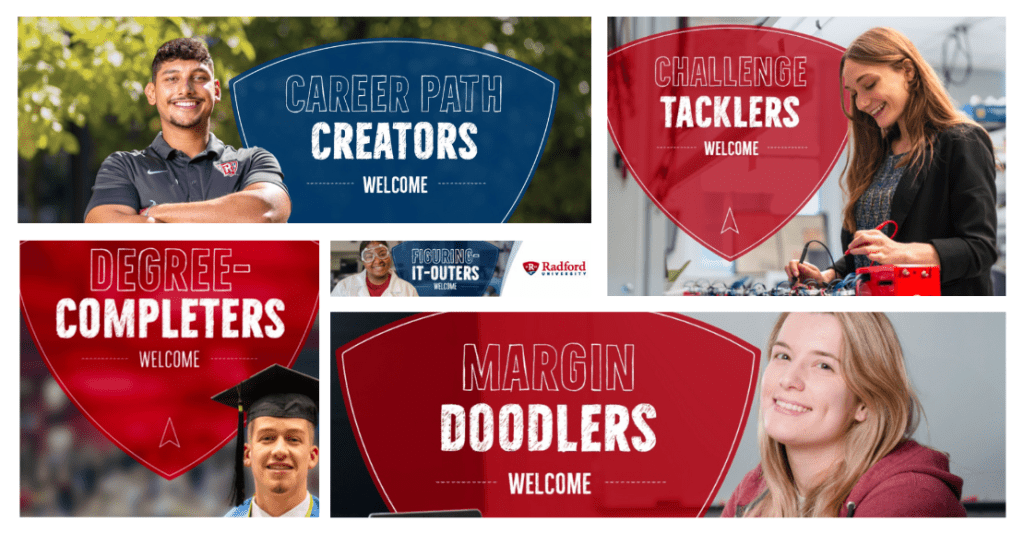
Radford University is another good example. When we started working together, our research found that Radford’s core messaging overlapped with many of its direct competitors, much like the pattern we saw across these 50 homepages. More than 100 stakeholders helped shape a new brand platform built around students’ curiosity, independence, and fearlessness, and a close-knit campus where they feel seen. Since then, freshman retention has risen 4.3%, Radford’s best growth since 1999, and the incoming class arrived with a record average high school GPA of 3.47.
Whether you’re planning a rebrand or refining a few pages, the principle holds: Creative has a much easier job when the strategy has already found the difference.
Run the Logo-Removal Test on Your Own Homepage
Here’s a fast exercise for your next marketing meeting. Screenshot your homepage hero, remove the logo, name, mascot, and geography, then hand it to someone who knows your competitive set.
Ask three questions:
- Recognition: Could they identify your institution from the message itself?
- Comparison: Could the same headline reasonably appear on three competitor sites?
- Proof: Does the page give them a reason to believe the promise?
We applied this test to all 50. All 25 public institutions in the sample failed it. Private institutions did only marginally better, with 23 of 25 failing the test. If the answer gets uncomfortable, that’s useful information. It gives your team a place to investigate instead of defaulting to “we need a new campaign.”
Across these 50 homepages, the pattern is consistent. Most institutions lead with the same handful of themes, and most make their central claim without anything a student can check. That gap is fixable, but that fix only starts with careful research and attentiveness to student needs.
If your team wants an outside perspective on where your brand stands, we’d love to talk it through. VisionPoint can review your brand and competitive set, help identify the institutional truths a competitor couldn’t claim with equal credibility, and show where the evidence you already have could do more work at the top of the page. Reach out to start that conversation via a complimentary audit and strategy session.
Let’s help the right students understand why your institution deserves a place on their list.

FAQ About University Branding
Brand differentiation is the process of identifying and expressing an institution’s specific, credible advantages so audiences can distinguish it from competitors. We’ve found the strongest differentiation comes from research and proof rather than broad claims that many institutions can make.
We recommend starting with research before creative execution. Compare homepage headlines, value propositions, proof points, program language, and campaign themes across the institutions students are most likely to consider alongside yours. Then connect the brand idea to specifics students can evaluate, such as programs, outcomes, cost, place, experience, and proof. The logo-removal test is a useful first diagnostic: In our review, 48 of 50 headlines failed it.
No. Higher education branding can be scoped at almost any size. An institution may need a full brand effort, but it may also benefit from narrower work such as refining positioning, identifying stronger proof points, updating message architecture, or aligning campaign and website language around existing brand research.
Positioning gives enrollment marketing a consistent reason for students to pay attention and compare. It can inform advertising, program pages, CRM communications, campus visits, counselor conversations, and yield content so those touchpoints reinforce the same institutional idea.
Schools can use branding to attract more students and parents by making the institution’s strongest claims specific, credible and easy to compare. That means pairing aspiration with evidence: cost and scholarship information, academic programs, outcomes, student proof, location advantages, and the experiences that make the institution easier to remember. Branding gives enrollment marketing a consistent idea to carry across the website, paid media, CRM, campus visits, and family-facing communications.
Methodology note
In September 2026, VisionPoint reviewed the homepages of 50 four-year U.S. colleges and universities across 31 states and all four census regions (12 Northeast, 14 South, 13 Midwest, 11 West), split evenly by sector at 25 public and 25 private nonprofit, and weighted toward the comprehensive and regional institutions that make up most competitive sets. Individual institutions are not named. For each homepage, we recorded the hero headline and the subheadline or first line of introductory copy directly beneath it, verbatim, and coded only that hero zone. We excluded statistics bands, ranking strips, and news feeds further down the page. We coded each homepage for theme, whether the hero pairs its claim with a verifiable specific, and whether the headline would survive a logo-removal test. Unsourced superlatives were coded as unproven.
The second pass covered the full homepage, including statistics bands, ranking strips, and news feeds, and recorded what proof appears anywhere on the page and where it sits. Homepages change quickly, so we report all findings as captured on a single date. We ran the same protocol on a separate sample of 50 institutions two days earlier, and the central results replicated closely: 37 of 50 homepages were both interchangeable and unproven in each sample, 32 of 50 carried a sourced ranking in each, and exactly one homepage in each showed a graduation rate.
Resources
- VisionPoint: The Sea of Sameness in Higher Education
- VisionPoint: Moving Traditional Undergraduate Students from Interest to Action in 2026
- VisionPoint Brand & Positioning Portfolio
- VisionPoint: Radford University case study
- VisionPoint: UAFS case study
- VisionPoint: Cal State, East Bay case study
- VisionPoint: University of Houston case study
- Inside Higher Ed: Where Enrollment Stands as Fall 2026 Approaches
- U.S. Department of Education: College Scorecard (earnings and completion data by institution)
- NCES College Navigator (graduation rates and net price by institution)